

For caregivers and healthcare facilities, the daily challenge of safely transferring a patient from a seated to a standing position is a high-risk task. Manual transfers place immense strain on the lower back and shoulders of caregivers, while simultaneously posing a fall risk for the patient. The solution lies in a specialized piece of equipment designed to bridge the gap between total dependence and independent mobility: the sit to stand lift. When you search for a sit to stand lift for sale, you are looking for more than just a mechanical device. You are investing in a system that promotes dignity, encourages patient participation, and fundamentally changes the safety dynamics of a transfer. These lifts are specifically engineered for individuals who possess some weight-bearing capacity and can actively assist in the standing motion, making them distinct from full-body sling lifts. They work by providing a stable pivot point and support for the knees and trunk, allowing the patient to stand naturally while the lift handles the majority of the physical load. This active involvement is crucial for maintaining muscle strength and circulation, which are often compromised in patients with limited mobility. By integrating this technology into a care plan, facilities can dramatically reduce workers' compensation claims related to patient handling injuries. The market for a sit to stand lift for sale has evolved significantly, with modern units offering features like electric height adjustment, ergonomic knee pads, and intuitive hand controls. Understanding the nuances of these devices is critical for making a procurement decision that benefits both the caregiver and the care recipient. The right lift transforms a strenuous, risky procedure into a smooth, controlled, and respectful interaction.
Understanding the Mechanics and Core Benefits of a Sit to Stand Lift
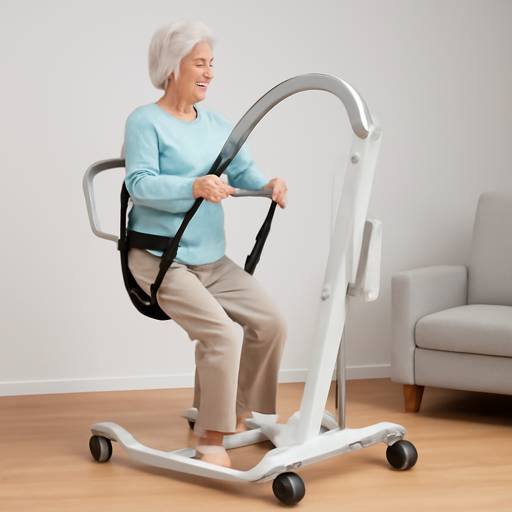
To fully appreciate the value of a sit to stand lift, one must first understand its operational mechanics and the specific physiological advantages it offers. Unlike a ceiling lift or a floor-based full-body lift, which transport a patient in a completely recumbent or seated position, the sit to stand lift requires the individual to be able to bear some weight on their lower extremities. The device typically features a sling that wraps around the patient's back and under their arms, while a padded knee block stabilizes the legs. As the lift arm raises, the patient is guided from a seated to a standing posture in a smooth, natural arc. This active lifting process is a significant therapeutic benefit. It engages the patient's core muscles and leg muscles, which can help prevent muscle atrophy and improve overall cardiovascular function. For the caregiver, the primary benefit is the elimination of biomechanical risk. Manual standing transfers often involve awkward twisting, reaching, and heavy lifting, which are the leading causes of musculoskeletal disorders in healthcare workers. A sit to stand lift replaces this dangerous strain with a simple, controlled mechanism that does the heavy work. The device shifts the force from the caregiver's spine to the machines hydraulics or electric motor. When evaluating options for a sit to stand lift for sale, it is imperative to look at the weight capacity and the range of motion. Premium models offer a safe working load (SWL) that accommodates bariatric patients, ensuring no caregiver is forced into a risky manual lift due to equipment limitations. Furthermore, the design of the knee block and sling is critical. A well-designed knee block provides a broad, comfortable surface that prevents the patient from sliding forward, while the sling must fit securely without cutting into the underarms. Many modern units come with a digital weight scale integrated into the frame, allowing care teams to track patient weight without additional transfers, a feature that is particularly valuable in long-term care facilities. The true genius of these lifts lies in their ability to restore a sense of normality. Patients who can stand, even with assistance, feel more independent and are often more willing to participate in their own care. This psychological boost is just as important as the physical safety benefits. The lift does not just raise a body; it raises the patient's spirits by enabling them to stand face-to-face with their caregiver, a simple act that is often taken for granted but is profound for someone with physical limitations.
Key Features to Evaluate When Shopping for a Sit to Stand Lift
Navigating the market for a sit to stand lift requires a careful evaluation of specific features that directly impact safety, usability, and long-term value. The first and most critical component is the base design and stability system. Most units feature a wheeled base that can be widened or narrowed. A wide base provides exceptional stability during the lift, preventing the device from tipping, especially when transferring a patient with a higher center of gravity. However, a narrower base is essential for maneuverability through doorways and tight bathroom spaces. Look for a model that offers a mechanical or electronic spreading base that locks securely into the desired position. Another crucial feature is the lifting mechanism itself. There are two primary types: electric actuator and hydraulic. Electric lifts offer a smooth, silent operation and allow for precise, incremental height adjustments. They are generally preferred for repeated use throughout the day due to their consistency and low physical effort required from the caregiver. Hydraulic lifts, while more affordable, often require a pumping motion that can be tiring over time and can be less precise. When searching for a sit to stand lift for sale, consider the battery life and backup systems of electric models. A high-quality unit should offer a full day of use on a single charge and include a manual emergency lowering system in case of power failure. The sling design is arguably the point of most direct contact with the patient. The sling should be made of a comfortable, breathable, and easy-to-clean material like nylon mesh or polyester. The attachment points are vital; look for quick-release clips or color-coded loops that simplify the process of attaching and detaching the sling. A poor sling fit can cause skin shear or bruising, so the ability to adjust the sling for different patient sizes is non-negotiable. The knee pad must be contoured and padded to prevent pressure points on the patella and tibia. Some advanced models feature removable, washable knee pads for hygiene. Do not overlook the hand control design. It should be ergonomic, with large, easy-to-press buttons that can be operated with limited dexterity. Many controls are now backlit or feature intuitive icons. Finally, consider the weight and portability of the lift itself. In a home care setting, a lift that is too heavy to push or too bulky to maneuver can become a burden instead of a help. A mid-range weight (around 80 to 100 pounds) often strikes the best balance between stability and portability. Reviewing these features in detail ensures that the lift you select is not just a tool, but a trusted partner in care.
Real-World Application: A Case Study in Home Care Efficiency
To illustrate the transformative impact of a sit to stand lift, consider the case of the Harrison family. For two years, Mr. Harrison, a 78-year-old stroke survivor with residual weakness on his left side, relied on his wife for all transfers. Mrs. Harrison, a 72-year-old, was performing up to ten manual standing transfers daily from the bed, the chair, and the toilet. This routine was unsustainable. Mrs. Harrison began experiencing chronic lower back pain and was at constant risk of falling along with her husband. The family decided to purchase a sit to stand lift, driven by the urgent need to find a sit to stand lift for sale that met their specific home layout and Mr. Harrison's capabilities. The unit they chose featured a compact wheelbase with a wide opening for stability and a padded knee block. The impact was immediate. The first transfer no longer required Mrs. Harrison to brace her feet and use her entire body weight to pull Mr. Harrison upward. Instead, she positioned the lift, attached the sling, and simply pressed a button. The lift guided her husband into a safe, steady stand. This had a profound effect on both of them. For Mrs. Harrison, the physical strain vanished. Her back pain subsided as she was no longer the primary lifting mechanism. For Mr. Harrison, the ability to actively stand, even with mechanical assistance, boosted his confidence. He reported feeling "less like a burden" and more willing to work on his standing balance during physical therapy. The operational efficiency of the lift allowed Mrs. Harrison to perform transfers in a fraction of the time, freeing up energy for other caregiving tasks like meal preparation and medication management. The real-world data from this case study aligns with broader healthcare research: the introduction of a sit to stand lift in a home care setting can reduce caregiver exertion by over 70%, reduce transfer times by 50%, and dramatically decrease the incidence of patient falls during transfers. The device also eliminated the need for Mrs. Harrison to call for help from neighbors or adult children, preserving the couple's sense of independence. The psychological benefit—the restoration of a safer, less stressful environment—was perhaps the most significant outcome of this investment. The automated system provided a level of predictability and control that manual handling could never match, turning a daily struggle into a simple, dignified procedure.


 Maria Dela Cruz