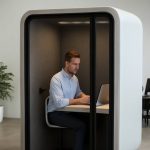
Open-plan offices promised collaboration, transparency and flexibility. In practice, they often deliver something else: constant background noise, visual distractions and a quiet shortage of places where people can speak freely. That tension has made the meeting pod one of the most practical additions to contemporary workplace design. Rather than forcing teams to choose between crowded boardrooms and exposed desk calls, a pod creates a small, self-contained room inside the larger floor plan. It can be used for a confidential interview, a rapid project huddle, a telehealth appointment, a client presentation or a focused video call without forcing everyone nearby to adapt.
The appeal is not just acoustic. A well-designed Meeting Pod also supports the way people actually work today: in short bursts, across time zones, with hybrid teammates and with a mix of in-person and remote participants. It gives organisations a way to add privacy without rebuilding walls, and it gives employees a reliable place to think, speak and be heard. As offices evolve from places people must attend into places people choose to use, pods help make that choice easier.
Why the Meeting Pod Has Become Essential in Open-Plan Workplaces
The modern office is no longer a single-purpose environment. It is a hub for mentoring, onboarding, brainstorming, deep work, client meetings and informal connection. Open-plan layouts can support those activities, but they struggle when several of them happen at once. A sales team on back-to-back calls, a design team reviewing prototypes and an HR manager conducting a sensitive conversation all create different acoustic and privacy needs. Without enclosed options, people either postpone important conversations, book rooms that are too large, or take calls from stairwells and cafés. A meeting pod resolves that daily friction by placing a small, bookable room exactly where the work happens.
One reason pods have become so popular is the rise of hybrid and distributed teams. When half a project team joins via video, the in-room experience matters as much as the remote experience. A pod with acoustic treatment, controlled lighting and reliable connectivity helps ensure that remote participants hear clear voices rather than ceiling fans, nearby conversations and keyboard clatter. It also gives the people on site a neutral, professional background for Teams, Zoom and Google Meet sessions. Instead of huddling around a laptop in a noisy breakout area, a small group can step into a pod, close the door and run a focused hybrid meeting.
There is also a real estate argument. Traditional construction adds cost, disruption and permanence. A modular pod can be installed in hours rather than weeks, and it can be relocated when a team expands, a department moves or a floor plan is reconfigured. That flexibility matters for growing companies, coworking operators, universities, clinics, airports and hotels that need private spaces but cannot commit to fixed drywall rooms. Pods allow organisations to add capacity incrementally: one focus booth today, a four-person pod next quarter, a larger conference pod when a new client team arrives.
Employee experience is another driver. Noise and lack of privacy are common complaints in employee surveys, and they affect more than comfort. They can undermine concentration, increase stress and make people feel exposed during sensitive conversations. A pod gives employees control over their environment. They can choose a quiet booth for deep work or a larger pod for a collaborative session. This is especially valuable for neurodivergent employees, people with hearing difficulties, nursing parents returning to work, or anyone who needs occasional relief from the sensory load of a busy office.
Local context matters too. In dense city centres where square footage is expensive, pods help teams use space more efficiently. In regional offices, they provide professional meeting settings without the cost of a full build-out. In coworking hubs, they offer members a premium amenity that supports client calls and confidential work. In education and healthcare, they create private zones for tutoring, counselling or telehealth. The common thread is simple: people need small, reliable, private rooms, and fixed architecture rarely keeps up with demand.
What Makes a Meeting Pod Effective: Acoustic, Technical and Human Factors
Not every enclosure deserves the name. An effective meeting pod must manage sound coming in, sound going out and sound generated inside the room. That requires more than a glass box with a door. High-performing pods typically use layered acoustic wall structures, sound-absorbing panels and sealed door systems to reduce speech transmission. Double-layer or laminated glass helps block noise while preserving visual openness, so people inside do not feel cut off from the office. Low-noise ventilation is equally important; if the fan is loud, users raise their voices, which defeats the purpose. The best designs balance acoustic separation with fresh airflow and comfortable temperature control.
Inside the pod, the details shape whether people actually use it. Integrated lighting should be adjustable enough for video calls, note-taking and presentations. Power outlets, USB charging and network connectivity need to be positioned where people naturally sit, not hidden under a table. A small display or mounting option can turn a two-person pod into a viable hybrid meeting space. Cable management keeps the room tidy and reduces setup time. When these elements are designed together, users can walk in, connect and start a call in seconds. When they are afterthoughts, the pod becomes a storage closet with a door.
Acoustic performance also depends on the pod’s interior finishes. Soft surfaces, such as PET acoustic panels or fabric walls, reduce echo and improve speech intelligibility. That matters for recorded meetings, accessibility and fatigue. A room that sounds hollow or reverberant forces people to concentrate harder, and remote participants hear a distracting boxy quality. By contrast, a well-tuned interior makes voices sound natural even during long sessions. Glass should be chosen carefully as well: it can provide visual connection, but it must be thick enough and properly sealed to prevent sound leaks at joints and frames.
Comfort is another practical factor. Meeting pods are often used for 15-minute stand-ups, but they may also host 60-minute interviews, client reviews or counselling sessions. Seating should support different postures, and the table should be sized for laptops, notebooks and perhaps a small display. Standing-height options can suit quick huddles, while seated configurations work better for longer conversations. Accessibility should be considered from the start: door width, internal turning space and controls within reach. A pod that excludes some employees is not a truly flexible workplace solution.
Real-world scenarios show how these factors combine. A law firm may use a two-person pod for confidential client calls, where speech privacy is non-negotiable. A software team may use a four-person pod for sprint planning, with a wall-mounted screen and reliable Wi-Fi. A university may place six-person pods in a library for group projects, where visual privacy and acoustic comfort help students focus. A hospital may use a single-person pod for telehealth consultations, protecting patient confidentiality while keeping clinical staff close to the ward. In each case, the pod succeeds because acoustics, technology and human needs are treated as one system, not separate features.
Matching Meeting Pod Sizes and Configurations to Real Business Scenarios
Choosing the right pod starts with occupancy and use case. A single-person focus pod or phone booth is ideal for individual video calls, online interviews, language tutoring or deep work. It offers privacy without removing the employee from the floor. A two-person pod supports one-on-one meetings, performance reviews, mentoring and confidential conversations. A four-person pod is often the sweet spot for team huddles, project check-ins and hybrid meetings with two or three remote participants. A six-person pod can host sprint reviews, client presentations, training sessions or small workshops. Larger conference pods serve bigger groups that need a dedicated room but do not want to build one permanently.
Configuration should follow the rhythm of the workplace. In a sales-driven office, quick-access two-person pods near the sales floor can reduce the time spent hunting for rooms. In a product and engineering environment, four-person pods with whiteboards or displays support rapid iteration. In a coworking space, a mix of one-person booths and four-person pods gives members options for calls, interviews and small client meetings. In education, six-person pods can turn open library or atrium space into bookable group-study rooms. In healthcare, one- and two-person pods can support telehealth, private consultations and administrative calls without occupying full exam rooms.
Deployment speed and relocation are part of the business case. Because pods are modular, they can be installed in hours rather than weeks, often without major disruption to the surrounding office. That means a company can pilot a few pods, measure utilisation and then expand. If a team moves to another floor, the pods can move with them. If a lease ends, they can be relocated rather than written off as construction. This flexibility is particularly valuable for fast-growing companies, seasonal operations, event venues and organisations that regularly reconfigure their spaces.
Customisation can also align pods with brand and function. Size, colour, materials, interior finishes, furniture and branding can be adapted for corporate offices, coworking hubs, universities, clinics, airports and hotels. A financial services firm may prefer a muted, professional palette. A creative agency may choose bold colours and graphics. An airport lounge may need durable surfaces and easy-clean fabrics. A hotel may want pods that match its lobby design while providing guests with a private place to take calls. The goal is not decoration for its own sake; it is to make the pod feel like a natural part of the environment so people use it confidently.
Case examples make the value tangible. A software company with an open floor plan adds four-person pods so daily stand-ups no longer disturb nearby developers. A consulting firm uses two-person pods for confidential client discussions and interview panels. A university library installs six-person pods to give students bookable group rooms without constructing new walls. A regional hospital places one-person pods near clinical teams for telehealth and administrative calls. A coworking operator uses a mix of focus booths and meeting pods to attract members who need professional spaces on demand. In each instance, the pod is not simply a room. It is a practical tool for protecting focus, enabling collaboration and making better use of existing square footage.