

What a Soundproof Pod Is—and Why Modern Teams Rely on It
Open-plan offices were built to spark collaboration, yet they often drown out the very focus that produces great work. A soundproof pod restores the missing ingredient: reliable, interruption-free quiet. Think of it as a compact, mobile room engineered for acoustic privacy, video-call clarity, and heads-down concentration. Unlike building new conference rooms, pods deploy in hours, slot into unused corners, and scale as teams grow—without permits, dust, or disruptive construction. The result is frictionless access to privacy that meshes with hybrid schedules and the real-time needs of creative and technical workflows.
At its core, a premium pod is a self-contained microspace with high-performance walls, double-laminated glass, magnetic or compression seals, silent ventilation, integrated lighting, and power. With the door closed, outside chatter drops away and the room’s interior is tuned to reduce echo so voices remain natural and intelligible. This acoustic isolation supports sensitive HR conversations, sales demos, code reviews, and remote interviews that cannot afford distractions or overheard content. By giving people a reliable refuge within steps of their desks, organizations lift the average quality of meetings and shorten the time it takes to switch from collaboration to deep focus.
Effective privacy comes from measurable acoustic performance. Exterior isolation is often expressed with lab ratings like STC or field ratings like NIC, while internal clarity hinges on absorption (NRC) and controlled reverberation. A well-built pod targets speech privacy by combining mass, damping, and airtight seals, which together reduce speech intelligibility outside. Inside, sound-absorbing panels keep RT60—the time it takes sound to decay—comfortably low so voices don’t bounce around. This dual approach ensures people outside aren’t disturbed and people inside can think clearly without raising their voices.
Material quality and engineering ultimately determine whether a pod is merely decorative or truly transformative. Choosing a Cepheus soundproof pod places emphasis on dense multi-layer walls, laminated safety glass, precision door seals, and quiet yet refreshing airflow—elements that separate premium solutions from lookalike enclosures. With durable finishes and integrated cable routing, these units feel like real rooms, not temporary booths, and they uplift the aesthetic of modern workplaces while supporting sustained productivity.
Design, Materials, and Acoustics: Inside a Premium Office Pod
Great pods begin with physics. To stop sound, walls must add mass and break vibration paths. Premium designs use a mass–spring–mass assembly: two rigid layers separated by a decoupling core that resists and dissipates energy. High-density boards, steel or engineered frames, and viscoelastic interlayers convert vibration into negligible heat, shrinking transmission across the panel. On the glazed side, laminated safety glass with an acoustic interlayer outperforms monolithic panes by reducing coincidence dips and controlling mid-to-high frequencies typical of speech. Perimeter gaskets and levelled thresholds close the last millimeter of leakage that would otherwise erode isolation.
Isolation is only half of the acoustic story. Inside the pod, the goal is intelligibility instead of reverberant “boxy” sound. That’s achieved by pairing thick PET felt, mineral wool, or micro-perforated panels with a layout that avoids parallel hard surfaces. Ceiling and rear walls typically provide most absorption to dial the reverberation time toward 0.3–0.4 seconds, a sweet spot for natural speech on calls. Light diffusion and strategic panel placement prevent flutter echoes, while a solid work surface and non-parallel geometry keep tonal coloration in check. The result is a calm, warm room tone that flatters voices, improves automatic speech recognition, and reduces listener fatigue across long meetings.
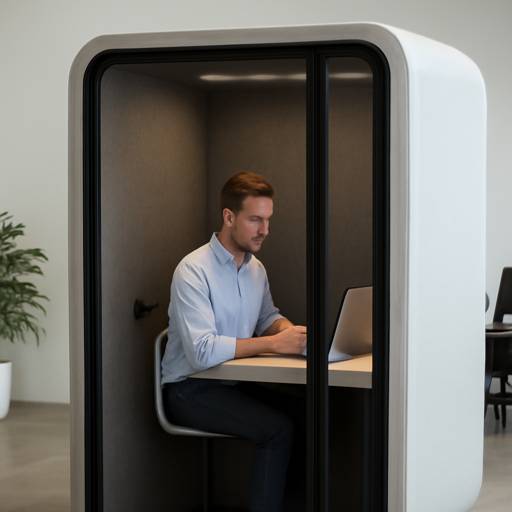
Comfort engineering matters as much as acoustics. Premium pods circulate fresh air quietly—often below 30 dB(A) at ear level—using low-vibration fans and tuned ducts so airflow doesn’t whistle through narrow gaps. Air turns over multiple times per hour without drafts. LEDs provide even, flicker-free light; many setups offer warm-to-cool tuning to match circadian needs or camera preferences. Thoughtful power modules support USB-C PD, AC outlets, and cable pass-throughs, with hidden routing to keep the desk clean. Sensor options for occupancy or CO₂ monitoring can automate lights and fans, preventing wasted energy during idle periods and maintaining comfort when the room is in use.
Sustainability and safety round out a mature specification. Look for low-VOC materials, E0/E1 or equivalent formaldehyde ratings, and third-party air-quality certifications that safeguard indoor health. Fire safety for panels and textiles, sturdy hardware, and scratch-resistant coatings extend the lifespan of visible surfaces. True premium builds are modular and serviceable: panels can be swapped, finishes refreshed, and components upgraded without replacing the entire unit. That modularity reduces total cost of ownership and supports circularity goals by keeping durable parts in service for longer, aligning investment with both performance and environmental responsibility.
Use Cases, ROI, and Real-World Examples from Agile Teams
Pods solve practical problems across industries. Engineering squads use them for code walkthroughs that must be quiet yet accessible; sales teams jump in for last-minute demos; HR schedules private check-ins without monopolizing large conference rooms; designers record voice-overs; clinicians and benefits counselors conduct confidential telehealth sessions. In coworking and campus settings, pods elevate the member and student experience by granting reliable privacy within a communal atmosphere. Because pods are furniture rather than fixed construction, facilities teams can reconfigure neighborhoods during reorganizations or floor consolidations without permits or downtime.
Returns arrive as reclaimed focus time, better meeting quality, and higher utilization of existing spaces. Consider a team of 80 knowledge workers in an open plan. If just 20 people each recover 12 minutes a day by stepping into a pod instead of waiting for a room—or by averting a noise-induced context switch—that’s four total hours of productivity returned per day. Over a year, those hours compound into weeks of equivalent work, dwarfing amortized lease costs. Add softer benefits: fewer rescheduled calls due to noise, improved candidate impressions during interviews, and a calmer soundscape that reduces stress and error rates across the floor.
Real-world rollouts underscore these gains. A 120-person fintech added six single-user pods near engineering and customer success. Within one quarter, meeting-room analytics showed a 19% reduction in small (two-person) bookings, freeing larger rooms for actual group sessions and cutting scheduling friction. A creative agency installed dual-occupancy pods with high NRC interiors for podcasting; postproduction cleanup time dropped by roughly a third because sessions started “clean,” and client feedback scores on audio clarity rose markedly. A university library placed four pods along a quiet-but-busy corridor and reported higher student satisfaction with study space access, especially during exam blocks when ambient noise peaks.
Getting placement right magnifies impact. Situate pods along circulation paths but offset from the noisiest printer nooks to avoid door-open spillover. Pair them with soft seating or plant clusters to build a gradient from collaboration to quiet. For hybrid teams, consider a “call spine” of pods near touchdown benches so remote standups don’t consume meeting rooms. Bookable vs. walk-up policies depend on culture; either way, short etiquette guides—door close, time limits, and cleanliness—keep spaces fair and fresh. Power is simple: a standard outlet often suffices, and many pods roll on leveling casters for quick moves. Accessibility planning—clear approaches, threshold height, and interior maneuvering room—ensures everyone benefits. Cepheus focuses exclusively on premium office pods, reflecting a belief that well-engineered microspaces unlock deep work, quieter floors, and more human meetings without remodeling walls or rewriting floor plans.

 Maria Dela Cruz