

What Are Rollers for Unloading Trucks—and Why They Transform Your Dock
Every minute a trailer sits at a dock, costs rise and customer promises drift. For busy distribution centers, parcel depots, and manufacturers receiving inbound materials, rollers for unloading trucks deliver a simple, scalable way to accelerate flow. At their core, these are modular frames fitted with low-friction cylinders that let cartons, totes, sacks, and irregular freight glide from the trailer to the warehouse floor with minimal manual handling. Whether configured as straight gravity lanes, flexible/expandable runs that snake into a trailer, or motor-driven zones, they convert dead time into productive motion.
Modern truck unloading solutions revolve around several families of equipment. Gravity roller conveyors remain the backbone: lines of steel or polymer rollers installed on a gentle decline so products roll by force of gravity. Flexible or accordion-style gravity conveyors add articulation, letting teams extend a lane deep into the trailer and then fold it compactly for storage. For higher control and zero-backup flow, motorized roller (MDR) conveyors create short powered zones that start, stop, and accumulate cartons with sensors—ideal when packages vary in weight or need gentle handling. At the high end, telescopic conveyors with roller or belt surfaces bridge the gap to the dock, providing powered in/out travel to reach far into 40-foot containers or 53-foot trailers.
Why do these systems matter? First, speed: moving boxes on low-friction rollers is dramatically faster than carrying or using hand trucks, cutting unload times by 20–50% in typical parcel operations. Second, ergonomics: less lifting means fewer strains, enabling teams to work longer and safer during peak periods. Third, consistency: standardized flow reduces drops, crush damage, and mis-sorts. Lastly, deployment is quick—many gravity systems roll into place on locking casters, and flexible lines can be reconfigured in minutes to match trailer types, seasonal surges, or a changing dock layout.
Industries that live on fast turns—express delivery networks, cross-border e-commerce, 3PLs, and high-mix manufacturers—gain particular value. In high-volume corridors and coastal gateways, where container throughput and parcel density intensify dock pressure, truck unloading rollers function as an operational shock absorber: they add capacity instantly without major construction, integrate cleanly with existing sorters or tuggers, and scale as volume grows. In short, they upgrade the dock from a labor bottleneck to a controlled flow center.
How to Choose the Right Roller System: Specifications That Matter
Selecting the best system starts with the product mix. Know the lightest and heaviest items, the smallest footprint, and the base condition. A basic rule of thumb is to keep at least three rollers under the shortest item at all times; that typically guides roller diameter and center spacing. Light cartons and totes often run well on 38–50 mm diameter rollers at 50–75 mm centers, while heavier crates may call for 60–76 mm rollers with reinforced shafts and frames. Roller materials include zinc-plated or galvanized steel for durability, stainless steel for wet or hygienic areas, and PVC or polymer sleeves for quieter handling or delicate surfaces. Precision bearings with labyrinth seals help keep dust out, which is essential in busy receiving docks where debris is common.
Frame construction and geometry also drive performance. Channel or formed-steel frames resist twisting under impact at the dock mouth. Choose usable widths that leave 25–50 mm clearance on each side of the largest load to avoid edge drag. For gravity lines, a slope of 2–5% generally maintains rolling speed; add speed controllers (centrifugal brakes) on inclines if heavy items risk runaway. End stops, toe guards, and handrails improve safety at transfer points, and smooth transition plates prevent snags between sections or where a telescopic conveyor meets a gravity spur. If packages are bagged or irregular, closely spaced rollers or skate-wheel alternatives can reduce hang-ups; however, true rollers handle mixed freight more consistently at the dock mouth.
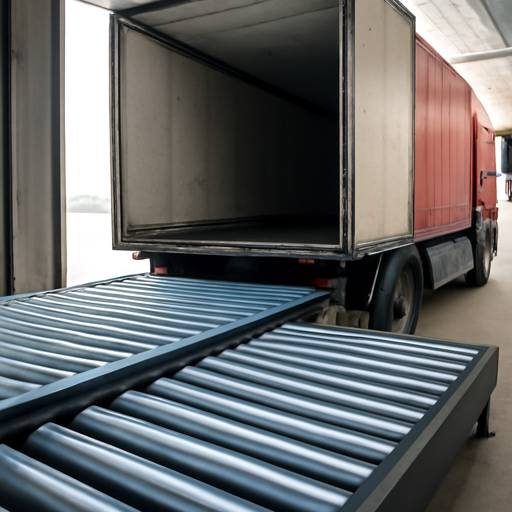
Environment and duty cycle influence materials and maintenance. Humid or coastal climates benefit from galvanized or powder-coated frames to resist corrosion. Cold-chain docks may need stainless components and low-temperature lubricants. If electronics or PCBs pass through, consider ESD-safe rollers and grounding straps. Noise is another factor: polymer-coated rollers and MDR zones reduce dBA levels during long shifts. Ergonomics matter too—set working heights between 700 and 900 mm, include adjustable stands for slope tuning, and specify high-quality casters with foot locks for mobile runs. When integrating with forklifts, dock levelers, or pallet jacks, ensure proper guarding around pinch points and verify compliance with CE/ISO norms and local safety codes.
Finally, think integration and future-proofing. MDR conveyors enable zero-pressure accumulation and zone control, with photo-eyes that minimize contact between items. Flexible gravity lines can dock into the outfeed of a telescopic boom to create a continuous path from trailer to sortation. Detail the control strategy—manual start/stop, local e-stops, or PLC integration—before purchase. Seek modular designs with readily available spare rollers and plug-and-play bearings to reduce downtime. Explore configurable rollers for unloading trucks that can be tailored to carton sizes, floor space, and automation roadmaps without locking operations into a single layout.
Real-World Deployments, Automation Paths, and ROI Benchmarks
Consider a high-volume parcel depot handling mixed e-commerce freight. Before optimization, teams staged boxes at the dock edge and hand-carried them to induction. By installing two telescopic roller conveyors with hydraulic elevation and pairing each with a 12–18 meter flexible gravity spur, unloaders now ride the boom to the nose of the trailer, place cartons onto the rollers, and let gravity do the rest. A job that took 80–90 minutes per 40-foot container now averages 45–55 minutes, while labor per door dropped from six to four people. Damage rates fell as stacked cartons no longer cascade to the floor, and the line feeds the sorter at a steadier rate, improving scan accuracy and SLA adherence.
In manufacturing receiving, the calculus shifts to weight and repeatability. An electronics assembler receiving palletized subassemblies and dense crates outfitted its inbound dock with heavy-duty 76 mm steel rollers on tight centers, impact plates at the dock edge, and MDR zones downstream to meter flow into kitting. Loaded crates transfer from the truck onto the roller bed via dock boards; operators rotate items on a turntable section for label visibility and scanning, then accumulate them in first-in, first-out lanes. By bringing the load to the team—rather than having the team chase loads—the site reduced travel, improved ergonomic scores, and cut non-value walking time by thousands of steps per shift.
Operational discipline keeps these gains reliable. Weekly checks should confirm roller spin, bearing noise, and frame alignment, with quick swaps for worn rollers to prevent scalloping and skew. Cleanliness matters: stray wrap, tape, or pallet chips can jam bearings or lift light parcels, so housekeeping standards at dock mouths pay dividends. For MDR lines, verify sensor alignment and zone logic; misreads can create gaps or back-pressure. Stock critical spares—rollers, bearings, photo-eyes, and belts or O-rings—and document changeover steps so a shift tech can restore flow in minutes. Train dock teams to set appropriate slopes on adjustable stands and to use end stops and brakes when unloading heavy or irregular freight.
Automation roadmaps increasingly fuse simple mechanics with smart control. Adding barcode tunnels and dimensioning at the end of a roller run captures data without adding touches. Linking telescopic conveyors to a warehouse execution system balances door assignments by volume and carrier arrival times. Seasonal elasticity—such as holiday surges—comes from modularity: roll out extra gravity lines during peak, then fold and store them after. Across parcel hubs, 3PLs, and inbound manufacturing cells, the ROI story is consistent: faster dock-to-stock times, fewer injuries, smoother induction, and reduced overtime. Many sites recover investments in rollers for unloading trucks within six to twelve months, especially where cross-border volumes or rapid SKU growth strain existing docks. By pairing rugged roller hardware with right-sized controls, facilities build an unloading engine that scales with demand—without sacrificing safety or space.


 Maria Dela Cruz